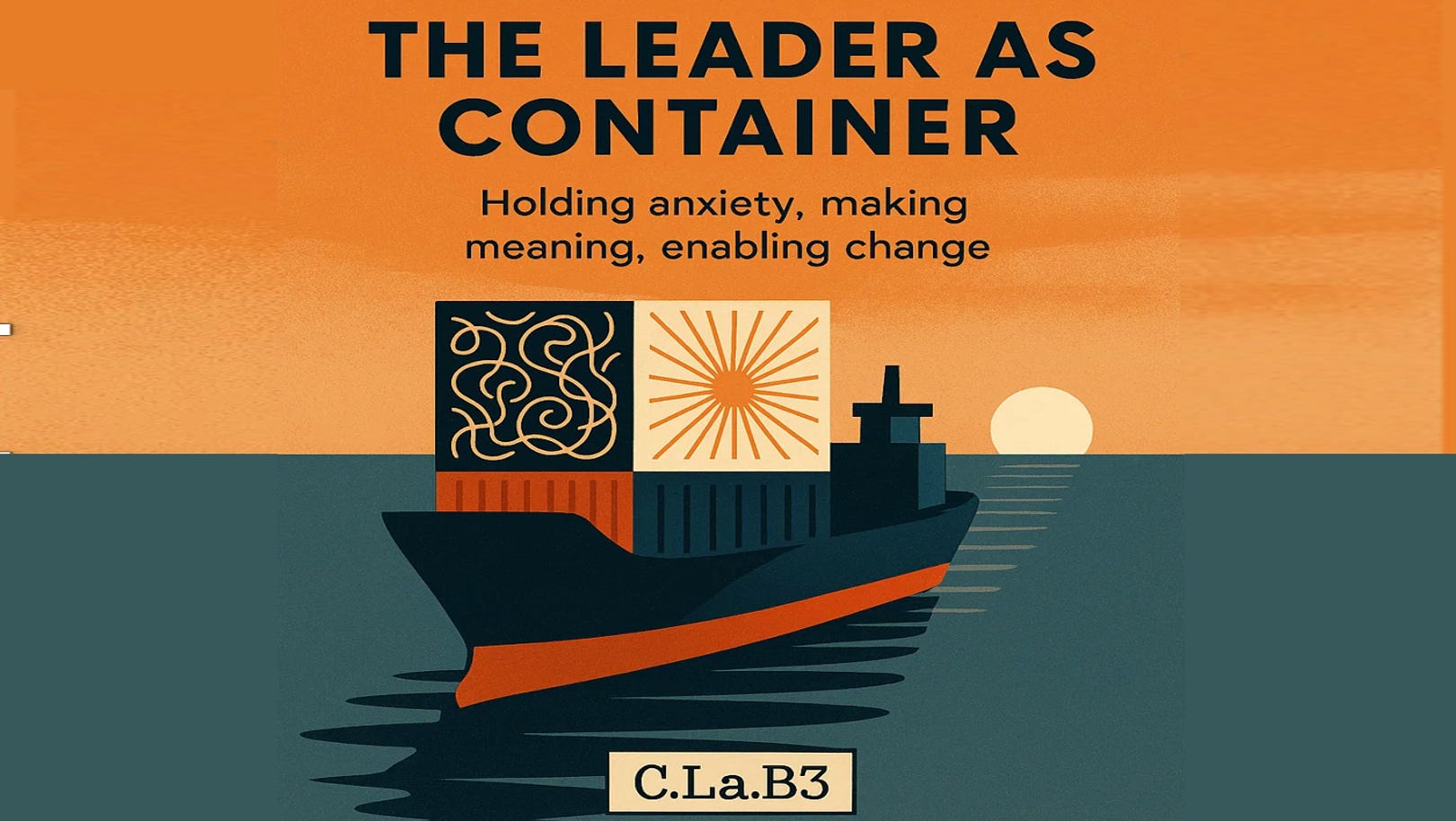
The Leader as Container
Holding Anxiety, Making Meaning, Enabling Change

Introduction
Change always arrives with more than plans and structures. It brings with it fear of the unknown, anxieties about competence, and threats to identity. These emotions ripple through systems, attaching themselves to those in authority. Leaders, willingly or not, become the vessels into which organizations pour their hopes, doubts, and projections.
This article traces the psychodynamic work of leadership as containment. Drawing on Susan Long, Manfred Kets de Vries, Konstantin Korotov, and Harry Levinson, I explore how leaders absorb anxiety, transform it into meaning, and return it to the system in a way that enables action. The fil rouge through the reading is that leadership is about holding the anxiety in the system long enough for others to see what is at stake so that all can move forward with clarity, together.
Anxiety at the Heart of Change
Every transformation evokes anxiety. Change unsettles what is familiar and stirs fears of loss, incompetence, or exclusion.
“Most human beings are inclined to avoid anxiety, uncertainty, and threats to their self-esteem. Therefore, they try to achieve control, predictability, and ways to enhance their self-esteem” (Prins, 2010).
In organizations, these efforts often take the form of defensive routines that provide the illusion of safety. Groups unconsciously collude to suppress anxiety, but it always returns, often in the form of resistance, passivity, or disengagement.
“People don’t tolerate anxiety well. Its appearance is a signal to do something to protect our integrity and to preserve our identity” (Zaleznik, 1997).
Leaders who reduce resistance to stubbornness or laziness miss the real work that is being signaled. It is a signal of something deeper that has not yet been voiced. What looks disruptive is often the organization’s attempt to manage what it cannot yet face directly.
Recognizing anxiety as the raw material of change reframes the leader’s task. Awareness is only the start to resolving anxiety. It must go somewhere. In organizational life, it flows in the direction of authority. This leads us to how leaders inevitably become the containers of what organizations cannot yet hold.
Leaders as Vessels of Projection
The leadership role is a charged encounter between person and system. The role meets the person, while the system finds its container.
“Role is at the intersection of the person and the system” (Long, 2006).
Leaders inherit unconscious expectations from predecessors and bring their own life history to the role. Long distinguishes the leader’s personal history in role from the history of the role itself:
“In their current work role, the client is at the intersection of their own role biography with the history of that role.” (Long, 2006).
The role exceeds the person and lives as a distinct object in the organizational mind, shaping expectations and behavior beyond the holder’s awareness. Kets de Vries captures the projection exchange more starkly:
“Followers project their fantasies onto their leaders, and leaders mirror themselves in the glow of their followers” (Kets de Vries, 2006).
Leaders become the screen for collective fears: paranoia, perfectionism, or fantasies of omnipotence. At the same time, many leaders battle their own internal narratives, such as the impostor fear of being found inadequate (Kets de Vries, 2005). With this awareness, it is now what to do about it as a next step.
“The identification of cognitive and affective distortions in an organization’s leaders and followers can help executives recognize the extent to which unconscious fantasies and out-of-awareness behavior affect decision-making and management practices in their organization” (Kets de Vries, 2006).
To lead, then, is to stand at the intersection of personal biography and systemic projection. The work of containment is absorbing these forces and turning what is projected into something that can be thought about and acted upon, which is where we turn in the next section.
Transforming Experience into Meaning
When leaders face and hold the tension in the system, they turn raw affect into clear direction and choose the right way to share it. The practical question is how leaders do this in role, reliably, under pressure. This requires a defined process and the capacity to treat tension as data. This becomes the playbook transforming experience into authentic action in role.
“By working as a person-in-role, experience can be subjected to a disciplined search for meaning, designed to lead to action” (Bazalgette, 2011).
Leaders metabolize anxiety and return it in usable form. In practice, containment means working the emotion, not bypassing it. It is the capacity to
“absorb, filter, or manage difficult or threatening emotions or ideas, the contained, so that they can be worked with” (French & Vince, 1999).
The task is to hold the anxiety of the organization until its members can bear to face it (Levinson, 2002). Those who rush to deny fear, clamp down with control, or offer premature reassurance discharge anxiety rather than transform it. Rather, they do it by naming what is in the room without blame, slowing the tempo so people can think, setting role and time boundaries, testing working hypotheses aloud, and translating emotion into task, choices, and next steps.
The ability to do this consistently is a discipline, cultivated through developmental practice. Which brings us to how leaders learn to expand their capacity to contain.
Learning Containment as a Discipline
Transitional space is necessary because people need holding to think and change. A holding environment is “a social context that reduces disturbing affect and facilitates sensemaking,” providing containment and interpretation so difficult feelings can be worked with rather than expelled (Petriglieri & Petriglieri, 2010). Programs built as an “identity laboratory” and transitional space make this concrete through clear boundaries, reflective rituals, and application back at work (Korotov, 2005; Florent-Treacy, 2009; Kim, 2011). These are:
“transitional spaces where leaders can reflect on their own role-taking and experiment with new ways of being” (Kets de Vries, Korotov & Florent-Treacy, 2007, p. 270).
At the individual level, two coaching programs can help leaders practice this work in role. Leadership 1:1 and Group Coaching provide stable support systems used to practice containment in live work. The objective is to slow the tempo, test working hypotheses in role, and translate affect into task. The expected outcome is a defined experiment after each session and a stronger capacity to hold heat without collapse.
Peer Supervision Circles are disciplined reflective spaces with clear roles and boundaries. The goal of the work is to surface projections, clarify limits, and convert anxiety into choices. What the group works towards is concise action notes, refined hypotheses about the system, and steadier presence in role(s). Work on role biography and role history can deepen both settings by separating the person’s story from the role’s legacy and generating focused hypotheses for next moves (Long, 2006; Long, 2013).
“Organizations can provide institutional holding through their policies and structure” (Petriglieri & Petriglieri, 2020),
and scale the practice through carefully designed programs.
Organizations can embed transitional space into their leadership system through recurring multi-module identity labs for priority roles, ongoing supervision groups with fixed cadence and confidentiality, and role-history reviews at each leadership transition so inherited anxieties are named and boundaries clarified (Florent-Treacy et al., 2013; Long, 2013). Everyday meeting hygiene brings the same logic: brief check-ins before decision work, explicit time and task boundaries, and end-of-cycle reviews that translate anxiety into choices create routine holding that reduces disturbing affect and supports sensemaking at scale (Petriglieri & Petriglieri, 2010).
By treating containment as a discipline, leaders can expand their range. Coaching, supervision, and structured programs provide the reflective holding that allows them to return to their organizations better able to hold others.
Conclusion
Change brings anxiety. Anxiety seeks a vessel. Leaders who contain it long enough to make meaning enable people to see what is at stake and move forward together.
The way forward is disciplined containment at two levels. Individually, leaders need steady containers where they can name what is in the room, slow the tempo, test working hypotheses, and translate feeling into task and next steps. Organizationally, systems need institutional holding through clear boundaries, recurring reflective spaces, and meeting hygiene that turns heat into choices.
In my practice, I build both. At the individual level this means Leadership 1:1 and Group Coaching, and Peer Supervision Circles that produce small, repeatable experiments and steadier presence in role. At the organizational level this means identity labs for priority roles, supervision groups with fixed cadence and confidentiality, role-history reviews at transitions, and brief check-ins and end-of-cycle reviews that make sense of anxiety before decisions.
When these containers are in place, anxiety becomes data, not noise. Leaders act from role, not reactivity. Teams think together instead of splitting or stalling. The organization develops a rhythm that holds pressure and converts it into clear direction. That is the work of leadership as containment, and it is how change becomes possible without the system being undone by its own fears.
If what you’ve read here struck a chord, there are a few ways we could take this conversation further:
Talks & Offsites – If you’re shaping a leadership retreat or planning a gathering where you want people to think differently, I can help spark that dialogue.
Executive Coaching – For new and experienced leaders navigating complexity, change, or the unspoken dynamics in their roles, I offer one-to-one coaching as a partner in the work.
You can reach me directly if one of these feels like the right next step.
Reflection
Anxiety at the Heart of Change. These questions help to explore your role as the vessel for what organizations cannot yet bear to face.
When resistance surfaces, what anxieties in the system might it be carrying?
How do you notice your own reactions when collective fear rises?
In what ways have you treated anxiety as noise rather than the signal for change?
Leaders as Vessels of Projection. These questions explore transforming projections into meaning rather than being consumed by them.
What expectations, fears, or fantasies are you holding on behalf of others?
How has your own history in roles shaped the way you absorb or resist these projections?
What unconscious legacies of the role itself may you be enacting without realizing it?
Transforming Experience into Meaning. These moments of transformation point to containment as a discipline, something learned and strengthened over time.
When do you find yourself moving too quickly to control or reassure instead of holding anxiety?
What helps you translate fear and confusion into clarity for others?
When have you turned collective anxiety into usable direction, and what made it possible?
Learning Containment as a Discipline. This is carrying what others cannot yet hold until the system is ready to face it.
How do you continue developing your ability to hold identity-level tensions, not just technical challenges?
What structures or relationships provide the transitional space for you to grow as a container for others?
----
References
Bazalgette, J. (2011). Leadership: The impact of the full human being in role. The Grubb Institute.
Florent-Treacy, E., Guillen, L., & Van de Loo, E. (2013). It’s about time you asked! Participants’ assessment of learning experiences in an executive developmental journey (INSEAD Working Paper No. 2013/119/EFE). Fontainebleau: INSEAD.
Florent-Treacy, E. (2009). Behind the scenes in the identity laboratory: Participants’ narratives of identity transition through group coaching in a leadership development program. International Coaching Psychology Review, 4(1), 71–85.
French, R., & Vince, R. 1999. Learning, managing and organizing: The continuing contribution of group relations to management and organization. In R. French & R. Vince (Eds.), Group relations, management, and organization: 3–19. Oxford, UK: Oxford University Press.
Kets de Vries, M. F. R. (2005). The dangers of feeling like a fake. Harvard Business Review, 83(9), 108–116.
Kets de Vries, M. F. R. (2006). The leader on the couch: A clinical approach to changing people and organizations. San Francisco, CA: Jossey-Bass.
Kets de Vries, M. F. R., Korotov, K., & Florent-Treacy, E. (2007). The transformational leadership development program: An owner’s manual. INSEAD Working Paper. Fontainebleau: INSEAD.
Kim, H. J. (2011). Executive coaching: Study of the evolution of the program at a top European business school (Unpublished doctoral dissertation). Teachers College, Columbia University, New York, NY.
Korotov, K. (2005). Identity laboratories (Unpublished doctoral dissertation). INSEAD, Fontainebleau, France.
Long, S. (2006). Drawing from role biography in Organizational Role Analysis. In : J. Newton, S. Long, & B. Seivers(Eds.), Coaching in Depth: The Organizational Role Analysis Method. (pp. 127-144). London: Karnac.
Long, S. (2013). Transforming experience into authentic action: A framework for psycho-social leadership development. In S. Long (Ed.), Socioanalytic methods: Discovering the hidden in organisations and social systems (pp. 3–20). London: Karnac.
Petriglieri, G., & Petriglieri, J. L. (2010). Identity workspaces: The case of business schools. Academy of Management Learning & Education, 9(1), 44–60
Petriglieri, G., & Petriglieri, J. L. (2020). The return of the oppressed: A systems psychodynamic approach to organization studies. Academy of Management Annals, 14(1), 411–449.
Prins, S. (2010). From competition to collaboration: Critical challenges and dynamics in multiparty collaboration. The Journal of Applied Behavioral Science 46(3), 281-312.
Zaleznik, A. (1997). Real work. Harvard Business Review, 75(6), 53–63.